
Dental Occlusion: Classification, Types, and Treatment
Do you have an overbite? How about an underbite? Have you ever thought about how your teeth fit together? This is what professionals call dental occlusion, and it’s a whole system in the body with complex parts that make up the jaw, teeth, and muscles. But how is dental occlusion classified and how is it treated? Find out in our recent guide.
What, exactly, is dental occlusion?
Beyond just how your teeth contact each other, dental occlusion is a complete, functional system that consists of three interconnected parts: the teeth, the temporomandibular joints (TMJs), and the neuromuscular system. Here’s a closer look at how these interconnected parts play a role in dental occlusion:
Teeth
The teeth, obviously, are the most visible part of dental occlusion. Going beyond just the appearance, this aspect involves how the upper and lower teeth meet when you chew, swallow, or rest. Ideally, pressure should be distributed evenly across all the teeth to prevent any individual tooth from taking too much force. Additionally, proper alignment can prevent grinding.
Temporomandibular joints (TMJ)
The TMJs are the two joints that connect your skull to your lower jaw. They’re unique because they can rotate and slide, hence dynamic occlusion. In a healthy occlusion, the teeth should come together fully at the same time that the jaw joint is in its most stable, relaxed position in the socket.
But if the teeth don't fit together properly, your jaw can shift out of its natural socket position to force the bite closed. This can lead to joint clicking, popping, or even inflammation.
Neuromuscular system
This includes the muscles (like the masseter and temporal) and the nerves that coordinate movement. The brain is constantly receiving signals from sensors around the roots of the teeth. So if it senses an interference (like a tooth hitting too early while chewing) the nervous system tells the muscles to change the motion of the jaw to avoid that spot.
This can eventually lead to muscle fatigue because they’re constantly working to "protect" the teeth or compensate for a misaligned joint. Not surprisingly, this then becomes the root cause of tension headaches, facial pain, and nighttime grinding, also known as bruxism.
Related: What Is an Occlusal Guard?
Are there different types of dental occlusion?
There are several key types of occlusion, including:
Static occlusion
Static occlusion is the way your upper and lower teeth make contact when your jaw is closed and stationary. It’s an overall snapshot of what your bite looks like while you’re resting. It also focuses on how the teeth fit together in a fixed position.
Dynamic occlusion
Dynamic occlusion or articulation is how your upper and lower teeth make contact when you’re moving your jaw. While static occlusion shows what your bite looks like at rest, dynamic occlusion is how your teeth interact during movements like chewing, swallowing, and speaking.
Centric occlusion
Technically, centric occlusion is the contact between your teeth when the jaw joint (mandible) is in centric relation (CR). This is the "joint-first" position where the condyles of the jaw fit perfectly and repeatedly in their sockets independent of how the teeth fit. For many people, the term “centric occlusion” is interchangeable with “maximum intercuspation,” or MIP for short. This is the position where your teeth have the most contact points and is your habitual bite.
Malocclusion
Essentially, malocclusion is a bad bite and refers to any kind of misalignment where the upper and lower teeth don’t fit together properly when the mouth is closed. While some cases are only cosmetic, a severe case of malocclusion can actually disrupt the entire functional system of dental occlusion. Over time, this can lead to jaw pain, tooth damage, and even difficulty speaking, chewing, or swallowing.
Related: Tartar vs Plaque: What’s the Difference?
Classes of dental occlusion
In dentistry, there are three classifications of dental occlusion:
1. Normal occlusion (Class I)
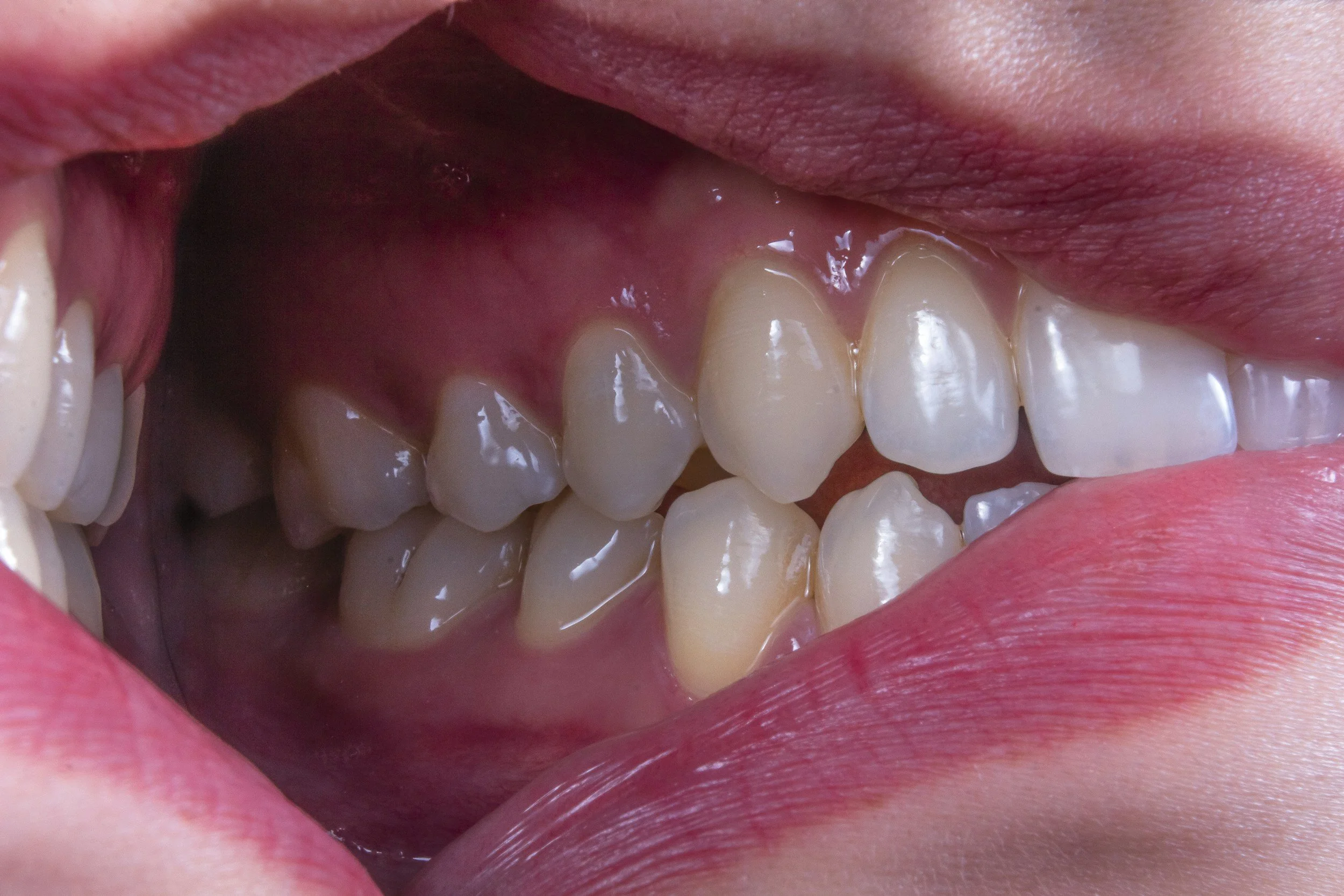
With normal dental occlusion, the upper molars fit properly with the lower molars. Additionally, the upper teeth should be slightly overlapping the lower teeth.
2. Malocclusion (Classes II and III)
Classes II and III of malocclusion encompass misalignments between molars. Class II malocclusion refers to an overbite (retrognathism), where the upper jaw and teeth severely overlap the bottom jaw. Most of the time, this is caused by an underdeveloped lower jaw.
Class III malocclusion refers to an underbite (prognathism), where the lower jaw protrudes forward past the upper jaw, causing the lower teeth to overlap the upper ones. This class of malocclusion typically comes from an overdeveloped lower jaw.
3. Balanced occlusion
Balanced occlusion refers to the simultaneous contact between the upper and lower teeth in both centric and eccentric positions. In other words, the “perfect bite.” A balanced occlusion is commonly used for making dentures. This is because, unlike a natural bite (which usually separates the back teeth when you move your jaw), a balanced occlusal bite keeps them touching to provide stability.
Related: How Much Do Dentures Cost?
What treatments are available for dental occlusion?
Depending on the type and class of dental occlusion, patients have several options for treatment:
Orthodontics
For cases of overcrowding, orthodontic-based treatments are often the go-to. Treatment options can include metal braces, ceramic braces, or clear aligners (like Invisalign) to move the teeth into their proper positions. Depending on the severity of occlusion, orthodontic treatment can take anywhere from 12 to 36 months.
Occlusal adjustment
During occlusal adjustment, a dentist removes tiny amounts of enamel or adds more material to the teeth. This ensures the upper and lower teeth meet evenly and helps reduce excessive force and tooth wear.
Restorative dentistry
Restorative dentistry such as crowns, dental inlays, or bridges can help correct the shape of the teeth, and improve the way they fit together. This treatment option is especially common for teeth that are worn down or missing.
Occlusal splints
Occlusal splints, or bite guards, are another treatment option, depending on the type and severity of the dental occlusion. These removable appliances are often worn at night and help relax the jaw muscles. They can also help protect the teeth against further damage from clenching or grinding.
Jaw surgery
Surgical intervention (orthognathic surgery) can also be a necessary treatment. Through jaw surgery, the provider repositions the jaw for proper alignment. While not the first treatment to consider, people who have severe cases of dental occlusion may find it necessary for overall health and wellbeing.
Tooth extraction
In cases of severe tooth overcrowding where orthodontics isn’t an option yet, extracting one or more teeth could be necessary. This helps to create enough room for the remaining teeth to be aligned properly.
Related: How Much Does Periodontal Disease Treatment Cost?
Schedule your next checkup at Coral Reef Dental!
Coral Reef Dentistry is Palm Harbor’s best in general dentistry and patient care. Get more information about our dental services or schedule your first consultation with our expert team. We’re here to help you keep your smile healthy and bright! Contact us today!